| ![Show Contents]() Armstrong History, Family Crest & Coats of Arms Armstrong History, Family Crest & Coats of Arms
Etymology of ArmstrongWhat does the name Armstrong mean? From the historical and enchanting region of Scotland emerged a multitude of noble families, including the distinguished Armstrong family. The Armstrong surname is thought to come from the Middle English words "strong" and "arm," and has also been rendered in Gaelic as MacGhillielaidir. Early Origins of the Armstrong familyThe surname Armstrong was first found in Cumberland. This once powerful well known Border family is derived from the Norman surname "Fortenbras" and is an instance of a surname assumed from a personal attribute, strength of arm. It is said that a Fairbairn, armour bearer to the King of Scotland, lifted the king back onto his horse with one arm, after the King had been unseated in battle. The King then granted him lands in Liddesdale and bestowed on him the name of Armstrong. 1 Although this legend may be true in part, the Armstrongs were of greater nobility than armour bearers. Perhaps the earliest recorded record is of Adam Armstrong, who was pardoned at Carlisle in 1235 for causing the death of another man. William Armestrangh served on an inquisition in the same city in 1274. 2 Some of the family were found in the burgh of Langholm, Dumfries in early times. "This place derives its name from the level lands, or holms, here, on the river Esk; and appears to have been indebted for its origin to the erection of an ancient border fortress by the powerful family of the Armstrongs, of which fortress the ruins are still in tolerable preservation." 3 Early History of the Armstrong familyThis web page shows only a small excerpt of our Armstrong research. Another 260 words (19 lines of text) covering the years 1328, 1342, 1363, 1376, 1529, 1587, 1602, 1610, 1633, 1658, 1662, 1672, 1683, 1684 and 1890 are included under the topic Early Armstrong History in all our PDF Extended History products and printed products wherever possible. Armstrong Spelling VariationsSpelling variations of this family name include: Armstrong, Armstrang, Armestrang, Harmestrang and many more. Early Notables of the Armstrong family- William Armstrong (c.1602-c.1658), known as Christie's Will, a Scottish Borders freebooter of the 17th century, celebrated in a ballad by Sir Walter Scott
- Colonel Sir Thomas Armstrong (died 1662), a Scottish soldier who fought in the 30 Years War in the Netherlands, a Royalist soldier during the English Civil War, twice imprisoned in the Tower of London...
- his son Sir Thomas Armstrong (c.1633-1684), an army officer and Member of Parliament, indicted for high treason for his involvement in the Rye House Plot in 1683
- Archibald Armstrong (died 1672), Scottish court jester, called "Archy," according to tradition first distinguished himself as a sheep-stealer
Armstrong World RankingIn Canada, the name Armstrong is the 101st most popular surname with an estimated 27,703 people with that name. 4 However, in the United States, the name Armstrong is ranked the 188th most popular surname with an estimated 131,811 people with that name. 5 And in Australia, the name Armstrong is the 100th popular surname with an estimated 25,791 people with that name. 6 New Zealand ranks Armstrong as 129th with 3,584 people. 7 The United Kingdom ranks Armstrong as 121st with 40,772 people. 8 Migration of the Armstrong family to IrelandSome of the Armstrong family moved to Ireland, but this topic is not covered in this excerpt.
Another 98 words (7 lines of text) about their life in Ireland is included in all our PDF Extended History products and printed products wherever possible.
| Armstrong migration to Canada | + |
Armstrong Settlers in Canada in the 18th Century- Andrew Armstrong, who was constable of the Ferryland district, Newfoundland, in 1730 10
- Christopher Armstrong, who arrived in Prince Edward Island in 1774
- Mr Al Welch Armstrong, U.E., United Empire Loyalist, who settled in Edwardsburgh [Township of Edwardsburgh/Cardinal], Ontario c. 1783 11
- Mr Edward Armstrong, U.E., United Empire Loyalist, who settled in Canada c. 1783 order in council May 12, 1808 11
- Mr Jesse Armstrong, U.E., United Empire Loyalist, who settled in Canada c. 1783 11
- ... (More are available in all our PDF Extended History products and printed products wherever possible.)
Armstrong Settlers in Canada in the 19th Century- Sophia Armstrong, who arrived in Canada in 1823
- Thomas Armstrong, who arrived in Canada in 1823
- Robert Armstrong, who arrived in Canada in 1823
- Rebecca Armstrong, who landed in Canada in 1823
- Margaret Armstrong, who arrived in Canada in 1823
- ... (More are available in all our PDF Extended History products and printed products wherever possible.)
| Armstrong migration to the United States | + |
Armstrong Settlers in United States in the 17th Century- Mr. Henry Armstrong, aged 22, who arrived in Virginia in 1635 aboard the ship "Transport" 12
- Gregory Armstrong, who arrived in Plymouth, Massachusetts in 1643 13
- Margarett Armstrong, who landed in Maryland in 1650 13
- Fra Armstrong, who landed in Virginia in 1652 13
- John Armstrong, who arrived in Virginia in 1653 13
- ... (More are available in all our PDF Extended History products and printed products wherever possible.)
Armstrong Settlers in United States in the 18th Century- Charles Armstrong, who landed in South Carolina in 1708 13
- Christiann Armstrong, who landed in Philadelphia, Pennsylvania in 1710 13
- David Armstrong, who landed in Charleston, South Carolina in 1717 13
- David Armstrong, who arrived in Charles Town [Charleston], South Carolina in 1717
- John William Armstrong, who landed in Charleston, South Carolina in 1717 13
- ... (More are available in all our PDF Extended History products and printed products wherever possible.)
Armstrong Settlers in United States in the 19th Century- James Armstrong, who landed in Somerset County, Pennsylvania in 1803 13
- John Armstrong, aged 29, who arrived in Philadelphia, Pennsylvania in 1803 13
- Joseph Armstrong, who landed in America in 1803 13
- Mathw Armstrong, aged 23, who landed in Delaware in 1803 13
- Mary Armstrong, aged 27, who landed in Philadelphia, Pennsylvania in 1803 13
- ... (More are available in all our PDF Extended History products and printed products wherever possible.)
Armstrong Settlers in United States in the 20th Century- Mr. Walter Armstrong, (b. 1884), aged 21, Cornish grocer, from Redruth, Cornwall travelling aboard the ship "St Paul" arriving at Ellis Island, New York on 25th June 1905 en route to Ishpenning, Michigan, USA 14
- John Robert Armstrong, who arrived in Wisconsin in 1908 13
- William Smith Armstrong, who arrived in Wisconsin in 1918 13
| Armstrong migration to Australia | + |
Emigration to Australia included the Second Fleet and Third Fleet of convicts, tradespeople and early settlers. Early immigrants include: Second Fleet - Mr. John Armstrong, (1767 - 1792), aged 23, Irish settler convicted in Monaghan, Ireland in 1790, sentenced to 7 years for stealing a horse, transported aboard the ship "Queen" leaving in 1790 arriving in New South Wales, Australia in 1791 9
Third Fleet Following the Second and Third Fleets, other convicts and early settlers arriving in Australia include: Armstrong Settlers in Australia in the 18th Century- Mr. John Armstrong, (b. 1758), aged 38, British settler who was convicted in Lancashire, England for 7 years for stealing, transported aboard the "Ganges" on 31st July 1796, arriving in New South Wales, Australia 15
Armstrong Settlers in Australia in the 19th Century- Miss Sarah Armstrong, British Convict who was convicted in Northumberland, England for 7 years, transported aboard the "Earl Cornwallis" in August 1800, arriving in New South Wales, Australia 16
- Mr. Robert Armstrong, British convict who was convicted in London, England for 7 years, transported aboard the "Calcutta" in February 1803, arriving in New South Wales, Australia, the settlement was listed as abandoned and most of the convicts transported to Tasmania on the "Queen" in 1804 17
- Mr. William Armstrong, British Convict who was convicted in Surrey, England for life, transported aboard the "Coromandel" on 4th December 1803, arriving in New South Wales, Australia 18
- Mr. Andrew Armstrong, Irish convict who was convicted in Dublin, Ireland for life, transported aboard the "Boyd" on 10th March 1809, arriving in New South Wales, Australia 19
- Mr.John Armstrong, British settler who was convicted in Yorkshire, England for life for stealing a horse, transported aboard the "Fortune" on 31st October 1812, arriving in New South Wales, Australia 15
- ... (More are available in all our PDF Extended History products and printed products wherever possible.)
| Armstrong migration to New Zealand | + |
Emigration to New Zealand followed in the footsteps of the European explorers, such as Captain Cook (1769-70): first came sealers, whalers, missionaries, and traders. By 1838, the British New Zealand Company had begun buying land from the Maori tribes, and selling it to settlers, and, after the Treaty of Waitangi in 1840, many British families set out on the arduous six month journey from Britain to Aotearoa to start a new life. Early immigrants include: Armstrong Settlers in New Zealand in the 19th Century- Robert Armstrong, who landed in Wellington, New Zealand in 1840
- John Armstrong, who arrived in Wellington, New Zealand aboard the ship "Whitby" in 1841
- Mr. Robert Armstrong, (b. 1816), aged 26, British settler travelling from London and Plymouth aboard the ship "Thomas Sparks" arriving in Wellington, New Zealand on 31st January 1843, the ship stuck rocks of the coast of Cape of Good Hope delaying her landing by 2 months 20
- Mrs. Catherine Armstrong, (b. 1815), aged 27, British settler travelling from London and Plymouth aboard the ship "Thomas Sparks" arriving in Wellington, New Zealand on 31st January 1843, the ship stuck rocks of the coast of Cape of Good Hope delaying her landing by 2 months 20
- Mr. Armstrong, (b. 1842), aged Infant, British settler travelling from London and Plymouth aboard the ship "Thomas Sparks" arriving in Wellington, New Zealand on 31st January 1843, the ship stuck rocks of the coast of Cape of Good Hope delaying her landing by 2 months, he died on board 20
- ... (More are available in all our PDF Extended History products and printed products wherever possible.)
| Armstrong migration to West Indies | + |
The British first settled the British West Indies around 1604. They made many attempts but failed in some to establish settlements on the Islands including Saint Lucia and Grenada. By 1627 they had managed to establish settlements on St. Kitts (St. Christopher) and Barbados, but by 1641 the Spanish had moved in and destroyed some of these including those at Providence Island. The British continued to expand the settlements including setting the First Federation in the British West Indies by 1674; some of the islands include Barbados, Bermuda, Cayman Island, Turks and Caicos, Jamaica and Belize then known as British Honduras. By the 1960's many of the islands became independent after the West Indies Federation which existed from 1958 to 1962 failed due to internal political conflicts. After this a number of Eastern Caribbean islands formed a free association. 21Armstrong Settlers in West Indies in the 17th Century- Miss Katherin Armstrong, (b. 1615), aged 20, British settler traveling aboard the ship "Matthew" arriving in St Christopher (Saint Kitts) in 1635 22
| Contemporary Notables of the name Armstrong (post 1700) | + |
- Neil Alden Armstrong (1930-2012), American NASA astronaut, first person to set foot on the moon and recipient of the Presidential Medal of Freedom 23
- Lord William Armstrong (1810-1900), Scottish industrialist, engineer, inventor of the hydraulic crane and the Armstrong gun; his house at Cragside was the first in the world to be lit by hydro-electricity, he later he acquired Bamburgh Castle, still owned by the family
- George Edward Armstrong (1930-2021), Canadian NHL ice hockey centre who played 21 seasons in the National Hockey League (NHL) for the Toronto Maple Leafs, the team's captain for 13 seasons, inducted into the Hockey Hall of Fame in 1975
- David "Neil" Armstrong (1932-2020), Canadian professional ice hockey linesman from Plympton, Ontario, inducted into the Hockey Hall of Fame
- Brigadier Francis Logie Armstrong (1886-1945), Canadian District Officer Commanding 3rd Military District from 1940 to 1945 24
- Jeannette Armstrong (b. 1948), Canadian author, educator, artist, and activist
- Sir Walter Armstrong (1850-1918), Scottish writer
- Edwin Howard Armstrong (1890-1954), American electrical engineer and inventor who developed FM (frequency modulation) radio and the superheterodyne receiver system; he held 42 patents and received numerous awards
- Ella Armstrong (1916-1978), née Letcher, American private in the 6888th Central Postal Directory Battalion, first all-female, all-African-American battalion to server overseas
- ... (Another 45 notables are available in all our PDF Extended History products and printed products wherever possible.)
| Historic Events for the Armstrong family | + |
- Mrs. R Armstrong (d. 1979), American passenger from Los Angeles, California, USA, who flew aboard American Airlines Flight 191 and died in the crash 25
- Mr. James Armstrong (1878-1914), Scottish Timber Packer from Lochfitty Beath, Fife, Scotland, United Kingdom who worked in the Hillcrest Coal Mine, Alberta, Canada and died in the mine collapse 26
- Mr. Harold James Armstrong (1917-1941), Australian Ordinary Seaman from Geelong West, Victoria, Australia, who sailed into battle aboard HMAS Sydney II and died in the sinking 27
- Edwin Francis Armstrong (d. 1945), British Telegraphist aboard the HMS Dorsetshire when she was struck by air bombers and sunk; he died in the sinking 28
- Mr. Norman Armstrong (b. 1920), English Able Seaman serving for the Royal Navy from Usworth, County Durham, England, who sailed into battle and died in the HMS Hood sinking 29
- ... (Another 15 entries are available in all our PDF Extended History products and printed products wherever possible.)
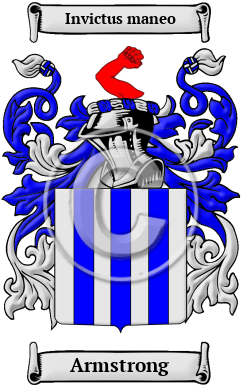
The motto was originally a war cry or slogan. Mottoes first began to be shown with arms in the 14th and 15th centuries, but were not in general use until the 17th century. Thus the oldest coats of arms generally do not include a motto. Mottoes seldom form part of the grant of arms: Under most heraldic authorities, a motto is an optional component of the coat of arms, and can be added to or changed at will; many families have chosen not to display a motto.
Motto: Invictus maneo
Motto Translation: I remain unvanquished.
| Suggested Readings for the name Armstrong | + |
- Ancestry Descendants of Daniel F. Armstrong and Sarah Nutter by Evelyn Crawford Fenton.
- Armstrong Ancestry: A Genealogy of the Descendants of Robert R. Armstrong by John Edward Armstrong.
- Polson, Alexander, The Romance of Scottish Crests and Mottoes. Inverness: Walter Alexander, Inglis Street 1929. Print
- Black, George F., The Surnames of Scotland Their Origin, Meaning and History. New York: New York Public Library, 1946. Print. (ISBN 0-87104-172-3)
- Lewis, Samuel, A Topographical Dictionary of Scotland. Institute of Historical Research, 1848, Print.
- "Surnames Meanings, Origins & Distribution Maps - Forebears." Forebears, https://forebears.io/surnames
- "What are the 5,000 Most Common Last Names in the U.S.?". NameCensus.com, https://namecensus.com/last-names/
- "Most Common Last Names in Australia." Forebears, https://forebears.io/australia/surnames
- "Most Common Last Names in New Zealand." Forebears, https://forebears.io/new-zealand/surnames
- "UK surname ranking." UK Surname map, https://www.surnamemap.eu/unitedkingdom/surnames_ranking.php?p=10
- Convict Records of Australia. Retrieved 4th February 2021 from https://convictrecords.com.au/ships
- Seary E.R., Family Names of the Island of Newfoundland, Montreal: McGill's-Queen's Universtity Press 1998 ISBN 0-7735-1782-0
- Rubincam, Milton. The Old United Empire Loyalists List. Genealogical Publishing Co., Inc, 1976. (Originally published as; United Empire Loyalists. The Centennial of the Settlement of Upper Canada. Rose Publishing Company, 1885.) ISBN 0-8063-0331-X
- Pilgrim Ship's of 1600's Retrieved January 6th 2023, retrieved from https://www.packrat-pro.com/ships/shiplist.htm
- Filby, P. William, Meyer, Mary K., Passenger and immigration lists index : a guide to published arrival records of about 500,000 passengers who came to the United States and Canada in the seventeenth, eighteenth, and nineteenth centuries. 1982-1985 Cumulated Supplements in Four Volumes Detroit, Mich. : Gale Research Co., 1985, Print (ISBN 0-8103-1795-8)
- Cornwall Online Parish Clerks. (Retreived 3rd May 2018). Retrieved from http://www.opc-cornwall.org/Resc/pdfs/emigration_ellis_island_1892_on.pdf
- Convict Records Voyages to Australia (Retrieved 24th October 2022). https://convictrecords.com.au
- Convict Records Voyages to Australia (Retrieved 13th August 2021). Retrieved from https://convictrecords.com.au/ships/earl-cornwallis
- Convict Records Voyages to Australia (Retrieved 25th November 2020). Retrieved from https://convictrecords.com.au/ships/calcutta
- Convict Records Voyages to Australia (Retrieved 22nd March 2021). Retrieved from https://convictrecords.com.au/ships/coromandel-and-experiment
- Convict Records Voyages to Australia (Retrieved 27th October 2020). Retrieved from https://convictrecords.com.au/ships/Boyd
- New Zealand Yesteryears Passenger Lists 1800 to 1900 (Retrieved 26th March 2019). Retrieved from http://www.yesteryears.co.nz/shipping/passlist.html
- https://en.wikipedia.org/wiki/British_West_Indies
- Pilgrim Ship's of 1600's (Retrieved October 4th 2021 from https://www.packrat-pro.com/ships/shiplist.htm
- NASA Astronauts Homepage. (Retrieved 2010, September 27) Neil Armstrong. Retrieved from http://www.jsc.nasa.gov/Bios/htmlbios/armstrong-na.html
- Generals of World War II. (Retrieved 2011, September 8) Francis Armstrong. Retrieved from http://generals.dk/general/Armstrong/Francis_Logie/Canada.html
- Flight 191's Victims - latimes. (Retrieved 2014, April 16) . Retrieved from http://articles.latimes.com/1985-08-04/news/mn-4349_1_fort-lauderdale-area
- List Of Miners - Hillcrest Mine Disaster Data. (Retrieved 2014, June 24) . Retrieved from http://www.hillcrestminedisaster.com/data/index.php?title=List_Of_Miners
- HMAS Sydney II, Finding Sydney Foundation - Roll of Honour. (Retrieved 2014, April 24) . Retrieved from http://www.findingsydney.com/roll.asp
- Force Z Survivors HMS Dorsetshire Crew List, (Retrieved 2018, February 13th), https://www.forcez-survivors.org.uk/biographies/listdorsetshirecrew.html
- H.M.S. Hood Association-Battle Cruiser Hood: Crew Information - H.M.S. Hood Rolls of Honour, Men Lost in the Sinking of H.M.S. Hood, 24th May 1941. (Retrieved 2016, July 15) . Retrieved from http://www.hmshood.com/crew/memorial/roh_24may41.htm
 |