| ![Show Contents]() Clord History, Family Crest & Coats of Arms Clord History, Family Crest & Coats of Arms
- Origins Available:
Scotland
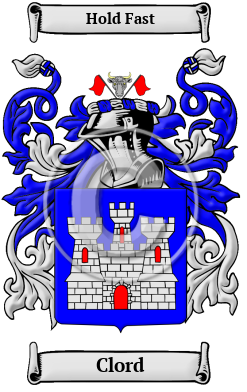
Etymology of ClordWhat does the name Clord mean? The west coast of Scotland and the rocky Hebrides islands are the ancient home of the Clord family. The root of their name is the personal name Leod. The Gaelic form of the surname is Mac Leoid, which means son of Leod, son of Olaf the Black, King of Man and the Northern Isles. Olaf was from a dynasty of Norse Kings, who, for centuries held the Isles. They were in turn descended from King Halfdan the Stingy, a King who was reputed to be descended from the god Frey. Leod held the island of Lewis, the mainland Glenelg and part of Skye in about 1195 AD. It was his two sons who founded the two great branches of the Siol Tormod and the Siol Torquil. Clord Coat of Arms CreationThe crest and motto of the Macleods are a bull's head and "Hold Fast." Of it the clan may well be proud, as it commemorates a brave deed by an ancestor at the prompting of sympathy and mercy. The story goes that one of the Dunvegan chiefs went to pay a visit to Argyle at Inverary. He chanced to arrive on the day appointed for the execution of one of Argyle's clansmen, whom his chief had condemned to be gored to death by a bull. A sort of arena had been prepared, and Argyle with his guests occupied seats raised above the space in which the tragedy was to be enacted. The bull, bellowing with rage, was led in, and presently the man appeared. He was a fine looking fellow, and showed no signs of fear as he faced the animal. MacLeod implored Argyle to forgive the man. Argyle, with a cruel smile, said it was too late as the man was with the bull in the arena and nothing could save him. " If I save him," said MacLeod, " will you give him to me ?" He sprang to his feet as he spoke, flung aside his cloak, and prepared for prompt action. " Yes," said Argyle, " if you save him he is yours, but you go to your death." Without another word MacLeod sprang into the arena, rushed for the bull and seized one of its horns by the left hand, and as he did so a cry rang out, " Vold fast." The next instant MacLeod struck a blow with his dirk which reached the beast's heart. The bull was killed and the man was saved. Even now there are Campbells living at Dunvegan who claim to be descended from the man. whom MacLeod saved, and a horn at Dunvegan is said to be one of those of the bull which MacLeod killed. 1 Early Origins of the Clord familyThe surname Clord was first found in on the Isle of Lewis (Scottish Gaelic: Leòdhas), where the Siol Tormod branch held the territories of Harris, Glenelg and Dunvegan Castle in Skye; while the Siol Torquil branch held Assynt and Cadboll, and the Island of Ramasay. There were no title deeds for these territories as they had been considered possessions of Norway. Yet when King Haakon asserted his authority over the lands in 1263 King Alexander resisted. Although the Scottish King Alexander signed the Treaty of Perth allowing payment of rent to Norway for all these lands, it was never paid and the whole of the western Isles became Scottish possessions. Early History of the Clord familyThis web page shows only a small excerpt of our Clord research. Another 380 words (27 lines of text) covering the years 1314, 1597, 1613, 1715, 1745, 1777, 1901 and 1959 are included under the topic Early Clord History in all our PDF Extended History products and printed products wherever possible. Clord Spelling VariationsSpelling and translation were not standardized practices until the last few centuries. Spelling variations are extremely common among early Scottish names. Clord has been spelled MacLeod, MacCleod, MacCloud, MacLoud and many more. Early Notables of the Clord familySir Roderick MacLeod of Dunvegan Castle who led 600 of his Clansmen to Ireland to assist in O'Donnell's rebellion and Lord MacLeod's Highlanders (73rd Regiment - later the 71st Regiment) which was raised in 1777, and saw service...
Another 38 words (3 lines of text) are included under the topic Early Clord Notables in all our PDF Extended History products and printed products wherever possible. Migration of the Clord familyNumerous Scottish settlers settled along the east coast of the colonies that would become the United States and Canada. Others traveled to the open country of the west. At the time of the American War of Independence, some remained in the United States, while those who remained loyal to the crown went north to Canada as United Empire Loyalists. The highland games and Clan societies that sprang up across North America in the 20th century have helped many Scots to recover parts of their lost traditions. Research into passenger and immigration lists has revealed some of the very first Clords to arrive in North America: Alan, Angus, Anne, Catherine, Donald, George, Jean, John, Malcolm, Margaret, Mary, Murdoch and his wife Christian; Neal and his wife Margaret and three children.
The motto was originally a war cry or slogan. Mottoes first began to be shown with arms in the 14th and 15th centuries, but were not in general use until the 17th century. Thus the oldest coats of arms generally do not include a motto. Mottoes seldom form part of the grant of arms: Under most heraldic authorities, a motto is an optional component of the coat of arms, and can be added to or changed at will; many families have chosen not to display a motto.
Motto: Hold Fast
- Polson, Alexander, The Romance of Scottish Crests and Mottoes. Inverness: Walter Alexander, Inglis Street 1929. Print
 |