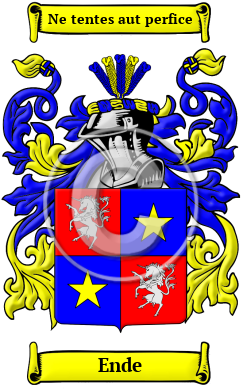
| ![Show Contents]() Ende History, Family Crest & Coats of Arms Ende History, Family Crest & Coats of Arms
- Origins Available:
Germany
Early Origins of the Ende familyThe surname Ende was first found in Saxony, where the name came from humble beginnings but gained a significant reputation for its contribution to the emerging mediaeval society. It later became more prominent as many branches of the same house acquired distant estates and branches, some in foreign countries, always elevating their social status by their great contributions to society. Early History of the Ende familyThis web page shows only a small excerpt of our Ende research. Another 113 words (8 lines of text) covering the years 1564, 1587 and 1767 are included under the topic Early Ende History in all our PDF Extended History products and printed products wherever possible. Ende Spelling VariationsSpelling variations of this family name include: Ende, End, Enden, Ender, Endern, Endegeest, Endepoel, Enderl, Enderlein, Enderli, Enderlin, Endermann, Enders, Endgasser, Endingen, Endorf and many more. Early Notables of the Ende family- the Ende family of Saxony
| Ende migration to the United States | + |
Ende Settlers in United States in the 18th Century- Martin Ende, who arrived in Pennsylvania in 1751 1
- Jacob Ende, who landed in Pennsylvania in 1754 1
- August Wilhelm Von Ende, who settled in North America in 1775
Ende Settlers in United States in the 19th Century- Fried Ludw Ende, who arrived in Pennsylvania in 1807 1
- F. R. Am Ende, who settled in New York in 1832
- Conrad Ende, who arrived in Allegany (Allegheny) County, Pennsylvania in 1850 1
- Ferdinand Von Ende, who landed in Iowa in 1851 1
| Contemporary Notables of the name Ende (post 1700) | + |
- Matt Vander Ende (b. 1969), American drummer and percussionist
- Harald Ende (b. 1929), German saxophone, flute and accordion player
- Hermann Gustav Louis Ende (1829-1907), German architect
- Michael Ende (1929-1995), German writer of fantasy novels and children's books
- Edgar Karl Alfons Ende (1901-1965), German surrealist painter, father of the children's noveliSt Michael Ende
The motto was originally a war cry or slogan. Mottoes first began to be shown with arms in the 14th and 15th centuries, but were not in general use until the 17th century. Thus the oldest coats of arms generally do not include a motto. Mottoes seldom form part of the grant of arms: Under most heraldic authorities, a motto is an optional component of the coat of arms, and can be added to or changed at will; many families have chosen not to display a motto.
Motto: Ne tentes aut perfice
Motto Translation: Attempt not or accomplish.
- Filby, P. William, Meyer, Mary K., Passenger and immigration lists index : a guide to published arrival records of about 500,000 passengers who came to the United States and Canada in the seventeenth, eighteenth, and nineteenth centuries. 1982-1985 Cumulated Supplements in Four Volumes Detroit, Mich. : Gale Research Co., 1985, Print (ISBN 0-8103-1795-8)
 |