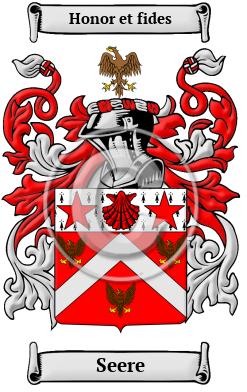
| ![Show Contents]() Seere History, Family Crest & Coats of Arms Seere History, Family Crest & Coats of Arms
Etymology of SeereWhat does the name Seere mean? The name Seere reached England in the great wave of migration following the Norman Conquest of 1066. The Seere family lived in Essex. Their name, however, is a reference to Serez, Normandy or at the Ville of Sayers, Normandy according to the Magni Rotuli Scaccarii Normanniae. 1 Alternatively, two sources claims the name was derived from an Anglo-Norman "personal name, as Saher de Quincy, the famous Earl of Winchester" or was perhaps "a forgotten personal name that has left an indelible mark on our directories. From twenty to twenty-five surnames separately spelt are the offspring, and many have a large number of representatives. The name was popular so early as Domesday as Segar and Sigar, and Latinized as Sigarus. " 2 One source believes the family was "an assayer of metals. 'When Domesday was compiled, there was always a fire ready in the Exchequer, and if they liked not the allay of the money, they burnt it, and then weighed it.' Hence the expression in Domesday, ' Lib. LVI arsas et pensatas'-56lb. burnt and weighed.-Kelham's Domesday, p. 157. The Sayer would therefore be a crown officer who assayed the precious metals." 3 Early Origins of the Seere familyThe surname Seere was first found in Essex where "the name of an old Colchester family of wealth and municipal consequence, " 4 some say from the reign of King Edmund Ironside in 1016, but this date conflicts with the more likely source of Serez, in the arrondisement of Evreux in Normandy, supporting the contention that the family was granted these lands after the Norman Conquest of England in 1066. "During the 14th century the Sayer family of Coppeford held of the King 82 acres of land in the village of Lachingdon." 4 They held a family seat there continuously from the Conquest to 1770. "As Sayer and Sayere it occurred in Norfolk, Beds, and Hants in the 13th century. The Sayers of Pulham, Norfolk, an ancient family, from which the Sayers of Eye, Suffolk, are derived, were lords of the manor of Pulham in the 17th and 18th centuries." 4 Early History of the Seere familyThis web page shows only a small excerpt of our Seere research. Another 94 words (7 lines of text) covering the year 1630 is included under the topic Early Seere History in all our PDF Extended History products and printed products wherever possible. Seere Spelling VariationsBefore the advent of the printing press and the first dictionaries, the English language was not standardized. Sound was what guided spelling in the Middle Ages, so one person's name was often recorded under several variations during a single lifetime. Spelling variations were common, even among the names of the most literate people. Known variations of the Seere family name include Sears, Seares, Seers, Seeres, Sear, Seare, Seer and many more. Early Notables of the Seere familyMore information is included under the topic Early Seere Notables in all our PDF Extended History products and printed products wherever possible. Migration of the Seere family to IrelandSome of the Seere family moved to Ireland, but this topic is not covered in this excerpt. More information about their life in Ireland is included in all our PDF Extended History products and printed products wherever possible.
| Seere migration to the United States | + |
To escape the political and religious chaos of this era, thousands of English families began to migrate to the New World in search of land and freedom from religious and political persecution. The passage was expensive and the ships were dark, crowded, and unsafe; however, those who made the voyage safely were encountered opportunities that were not available to them in their homeland. Many of the families that reached the New World at this time went on to make important contributions to the emerging nations of the United States and Canada. Research into various historical records has revealed some of first members of the Seere family to immigrate North America:
Seere Settlers in United States in the 17th Century- Francis Seere, who landed in Virginia in 1651 5
- Abigall Seere, who arrived in Virginia in 1662 5
| Seere migration to West Indies | + |
The British first settled the British West Indies around 1604. They made many attempts but failed in some to establish settlements on the Islands including Saint Lucia and Grenada. By 1627 they had managed to establish settlements on St. Kitts (St. Christopher) and Barbados, but by 1641 the Spanish had moved in and destroyed some of these including those at Providence Island. The British continued to expand the settlements including setting the First Federation in the British West Indies by 1674; some of the islands include Barbados, Bermuda, Cayman Island, Turks and Caicos, Jamaica and Belize then known as British Honduras. By the 1960's many of the islands became independent after the West Indies Federation which existed from 1958 to 1962 failed due to internal political conflicts. After this a number of Eastern Caribbean islands formed a free association. 6Seere Settlers in West Indies in the 17th Century- Mr. William Seere, aged 22, British settler travelling from Gravesend, UK aboard the ship "Hopewell" arriving in Barbados on 17th February 1634 5
The motto was originally a war cry or slogan. Mottoes first began to be shown with arms in the 14th and 15th centuries, but were not in general use until the 17th century. Thus the oldest coats of arms generally do not include a motto. Mottoes seldom form part of the grant of arms: Under most heraldic authorities, a motto is an optional component of the coat of arms, and can be added to or changed at will; many families have chosen not to display a motto.
Motto: Honor et fides
Motto Translation: Honor and fidelity.
- The Norman People and Their Existing Descendants in the British Dominions and the United States Of America. Baltimore: Genealogical Publishing, 1975. Print. (ISBN 0-8063-0636-X)
- Bardsley, C.W, A Dictionary of English and Welsh Surnames: With Special American Instances. Wiltshire: Heraldry Today, 1901. Print. (ISBN 0-900455-44-6)
- Lower, Mark Anthony, Patronymica Britannica, A Dictionary of Family Names of the United Kingdom. London: John Russel Smith, 1860. Print.
- Guppy, Henry Brougham, Homes of Family Names in Great Britain. 1890. Print.
- Filby, P. William, Meyer, Mary K., Passenger and immigration lists index : a guide to published arrival records of about 500,000 passengers who came to the United States and Canada in the seventeenth, eighteenth, and nineteenth centuries. 1982-1985 Cumulated Supplements in Four Volumes Detroit, Mich. : Gale Research Co., 1985, Print (ISBN 0-8103-1795-8)
- https://en.wikipedia.org/wiki/British_West_Indies
 |