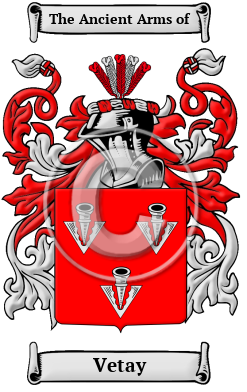
The many centuries old Dalriadan-Scottish name Vetay comes from Veaty. Mac means son of.MacVitti, therefore, means son of Vitti. Over time, the spelling of the name has changed, which is why the MacVitti is descended from Veaty.
Loading...
Early Origins of the Vetay family
The surname Vetay was first found in Ayrshire, and Galloway where they held a family seat from early times and their first records appeared on the census rolls taken by the ancient Kings of Scotland to determine the rate of taxation of their subjects.
Early History of the Vetay family
This web page shows only a small excerpt of our Vetay research. Another 97 words (7 lines of text) covering the years 1560, 1574, 1627, 1685 and 1686 are included under the topic Early Vetay History in all our PDF Extended History products and printed products wherever possible.
Vetay Spelling Variations
Spelling and translation were not standardized practices until the last few centuries. Spelling variations are extremely common among early Scottish names. Vetay has been spelled MacVittie, MacVittye, MacVittae, MacWittie, MacWitty and many more.
Early Notables of the Vetay family
More information is included under the topic Early Vetay Notables in all our PDF Extended History products and printed products wherever possible.
Loading...
Loading...
Loading...
Loading...
Migration of the Vetay family
Many who arrived from Scotland settled along the east coast of North America in communities that would go on to become the backbones of the young nations of the United States and Canada. In the American War of Independence, many settlers who remained loyal to England went north to Canada as United Empire Loyalists. Their descendants later began to recover the lost Scottish heritage through events such as the highland games that dot North America in the summer months. Research into various historical records revealed some of first members of the Vetay family emigrate to North America: Alan MacWittie who settled in New England in 1685; Duncan McVittie arrived in Philadelphia, Pennsylvania in 1775.