Scotland's Historic Regions and their Importance in Surname History
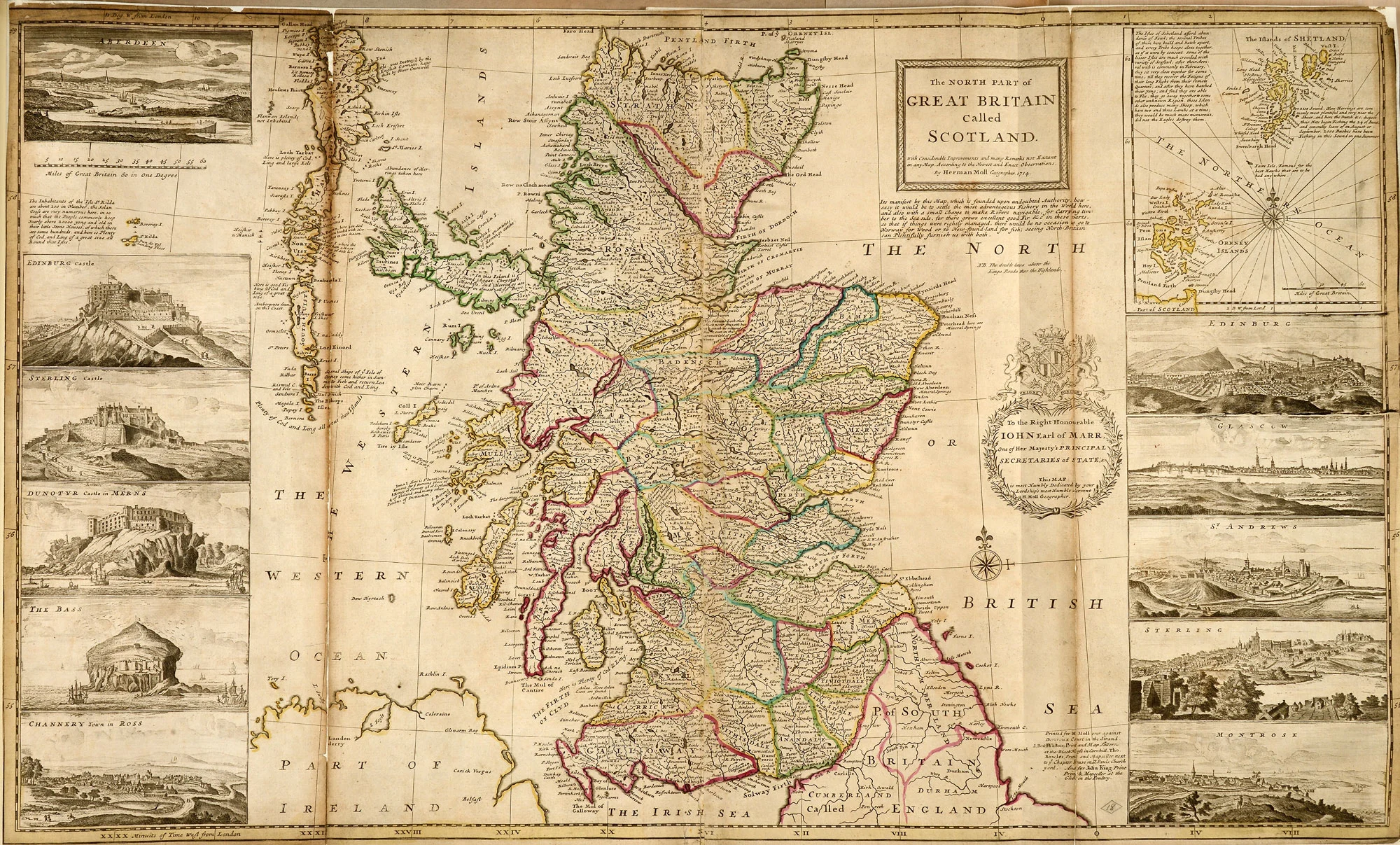
Scotland's older regional divisions remain central to understanding where many surnames first took shape. These areas influenced language, Clan territories, and social organization. Though modern boundaries no longer follow these lines, the historic regions still offer valuable context for anyone tracing the origins of a Scottish surname.
BORDERS
Positioned along the frontier with England, the Borders region includes the historic counties of Selkirkshire, Roxburghshire, Ettrick & Lauderdale, Berwickshire, Peebleshire, and Berwick. Border life, marked by long periods of conflict and shifting alliances, shaped the development of many surnames in this area.
Exploring surnames such as Armstrong, Elliot, or Scott, one may notice themes that often reflect a defense-oriented, territorial life.
GRAMPIAN
In the northeast, Grampian borders the Highlands and Tayside and includes the ancient counties of Aberdeen, Moray, and Banff. The region was home to several influential medieval families whose surnames and heraldic devices are well represented in northern armorial sources.
FIFE
Fife lies along Scotland's eastern coast and contains the historic counties of Fife and Kincardine. Its longstanding connection to the Scottish crown helped shape the surnames still found in early charters.
HIGHLAND
The Highlands, Scotland's largest historic region, includes Caithness, Sutherland, Nairn, and parts of Inverness and Ross and Cromarty. Highland surnames, many of which appear in Gaelic form, often reflect heraldic themes linked to Clan territory and tradition. Many of Scotland's most widely recognized surnames originated here, and heraldic symbols associated with them often reflect longstanding Gaelic traditions.
LOTHIAN
Located in the southeast, Lothian borders the Firth of Forth and includes East Lothian, Midlothian, West Lothian, and Edinburgh. The region's medieval burghs and close ties to the Scottish crown influenced surname development and contributed to the heraldic record preserved in Lowland sources.
ORKNEY
The Orkney Islands lie to the far north and were historically shaped by substantial Norse influence. In medieval records, they appear as the County of Orkney. Surnames from the islands often reflect this dual heritage, and heraldic themes from the region frequently feature maritime or Nordic elements.
SHETLAND
Historically known as Zetland, the Shetland Islands sit northeast of Orkney. The region's Scandinavian heritage is visible in both local surnames and the heraldic symbolism tied to early families recorded in the area.
STRATHCLYDE
The Strathclyde region is another large geographical area, which is in the west. It is bordered to the north, by the Highland region, to the east, in descending order, by Tayside, Central, Lothian, and Borders, and in the south, by Dumfries and Galloway. The ancient counties contained within this region are Renfrew, Argyll, Lanark, Bute, and Ayr. The western part of the county of Peebles is also in this region.
WESTERN ISLES
The Western Isles (Outer Hebrides) lie west of the Highlands and historically included parts of Inverness and Ross and Cromarty. The region's strong Gaelic heritage is preserved in island surnames and in the symbolism associated with them.
TAYSIDE
The region of Tayside is in central eastern Scotland. This county includes Kinross, Angus, and Perth. Historical developments in monastic, market, and feudal life contributed to the surname patterns found in the region.
Regional Patterns
Distinctive regional influences can be observed in Scottish history. Gaelic imagery is common in the Highland Coat of Arms, while maritime symbols are found in island regions and martial or defensive motifs are associated with Borders surnames. These patterns offer helpful context when viewing these surnames and Coats of Arms.References
- ^ Swyrich, Archive materials
- Skene, William F. Celtic Scotland: A History of Ancient Alban. Vol. 3, David Douglas, 1880.
- Fraser, George MacDonald. The Steel Bonnets: The Story of the Anglo-Scottish Border Reivers. HarperCollins, 2005.
- Barrow, G.W.S. Kingship and Unity: Scotland 1000–1306. Edinburgh University Press, 1981.
- Grant, Alexander. Independence and Nationhood: Scotland 1306–1469. Edward Arnold, 1984.
- Watson, FIona. Scotland: A History. Tempus Publishing, 2002.
- Prebble, John. The Highland Clearances. Penguin, 1963.
- Oram, Richard. David I: The King Who Made Scotland. Tempus, 2004.
- Crawford, Barbara E. The Northern Earldoms: Orkney and Caithness from AD 870 to 1470. John Donald, 2013.
- Crawford, Barbara E. Scandinavian Scotland. Leicester University Press, 1987.
- MacQuarrie, Alan. The Kings of Strathclyde. John Donald, 1993.
- Lawson, Bill. Hebridean Genealogies. Argyll Publishing, 1997.
- Lynch, Michael. Scotland: A New History. Pimlico, 1992.