
Understanding the Feudal System and Its Influence on Surnames
The feudal system lasted roughly six centuries, shaping European society from the early Middle Ages until the rise of the modern state. While its organization varied from nation to nation and manor to manor, the core principle was consistent: lords received large tracts of land, and in return, those who swore allegiance to them gained protection and access to the lord's estate and court.1
In practice, the system reflected economic and military dependence. Commoners, including serfs and freemen, provided labour or military service to their superiors in exchange for protection. This created a society sharply divided into two broad groups: landholders (controlled estates) and those bound to the land.
Origins and Spread of Feudalism
After the fall of the Roman Empire in the 5th century, migrating Barbarian tribes helped introduce feudal structures across Europe.2 While feudal concepts initially took root in Italy and Germany, the system developed most fully in France.
Early feudal communities included a mix of slaves, serfs, and freemen. Serfs typically farmed land owned by a lord or Baron, while free serfs often built villages around baronial estates. Freeman, on the other hand, included nobles, clergy, merchants, artisans, and peasants who owned land with minimal obligations to feudal superiors.
The Hierarchy of Feudal Power
Barons often managed multiple estates, and in medieval Europe, landownership became the primary source of wealth and influence.3 The feudal hierarchy extended from kings and the church down to peasants and labourers. At the top, the king ruled both as a secular authority and, theoretically, as a vassal of God, governed by divine right. The church also maintained a hierarchical, feudal structure with the pope as its head.
Below these leaders, judges and administrators of civil law often relied on local custom, as formal literacy was rare. In many cases, law and tradition were inseparable. This system of mutual obligations defined the social, economic, and political life of Europe for centuries.
Chivalry, Knighthood, and Surname Identity
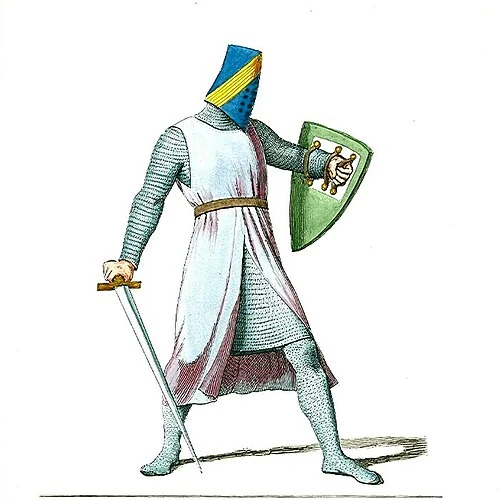
Feudal society was also shaped by traditions of chivalry and knighthood, emphasizing honour, loyalty, and service. These values often influenced the development of heraldry and surnames, which identified individuals and families within the feudal hierarchy.
Many surnames from this period carry symbolic designs inspired by medieval estates, knightly service, or feudal duties. Such heraldic emblems were visual markers of a family's place within the social structure and often drew from the ideals of protection, loyalty, and honour that defined feudal life.
FAQs
What was the main purpose of the feudal system?
It organized medieval society around land ownership, mutual protection, and service relations between lords and their vassals.
How did surnames develop under feudalism?
Many surnames originated from estates, occupations, or titles, reflecting the hierarchical and service-based structure of society.
References
- Bloch, Marc. Feudal Society: Vol. 1, The Growth of Ties of Dependence. Routledge & Kegan Paul, 1961.
- Ganshof, François-Louis. Feudalism. Harper & Row, 1964.
- Hilton, R.H. The English Peasantry in the Later Middle Ages. Clarendon Press, 1975.
- Swyrich, Archive materials