| ![Show Contents]() Chestere History, Family Crest & Coats of Arms Chestere History, Family Crest & Coats of Arms
- Origins Available:
England
Etymology of ChestereWhat does the name Chestere mean? The ancient history of the Chestere name begins with the ancient Anglo-Saxon tribes of Britain. The name is derived from when the family resided in Chester, which is the capital city of the county of Cheshire, which lies on the border between England and Wales; it is the northernmost county on the border. Devastated in the 11th century by border wars between William the Conqueror and the Welsh, Cheshire's border with Wales fluctuated over the next several centuries. Today, the western portion of the Domesday era county is in Wales. "Many places where Roman and other military stations (castra) existed are called chesters, and residence at such a spot may have conferred the surname. " 1 Early Origins of the Chestere familyThe surname Chestere was first found in Chester. This ancient Roman and later, Saxon city was known as Legacaestir in 735 and by the time of the Domesday Book of 1086, it was known as Cestre. "The city was originally known as Deoua from its situation on the River Dee, but later was known as Legacaestir, meaning 'city of legions.' " 2 "From the city of Chester, the capital of Cheshire, England, founded by the Romans. The name is derived from the Latin Castrum; Saxon, ceaster, a fortified place, a city, a castle or camp, it being a Roman station where the twentieth legion was quartered. " 3 Robert Chester (fl. 1182), was an early English astronomer and alchemist who took his name from the place of his birth. "Trained in the ordinary learning of his time, he turned aside from it to pursue mathematical studies, in which he gained a high reputation." 4 Roger of Chester (fl. 1339), is "almost beyond doubt the same person with Ranulf Higden, the chronicler, like whom he is described as a monk of St. Werburg's at Chester." 4 The Pipe Rolls of Lincolnshire listed Richard de Cestre there in 1200 and John, William de Chester was listed in the Subsidy Rolls of Warwickshire in 1332. A few years later, John Chestre was listed in the Feet of Fines for 1366-1367. 5 The Hundredorum Rolls of 1273 listed Petrus de Cestre in Yorkshire and William de Cestre in Bedfordshire. Kirby's Quest listed William de Chestere, Somerset, 1 Edward III (during the first year of King Edward III's reign.) 6 The Yorkshire Poll Tax Rolls of 1379 listed Elisabet de Chester and Cristiana de Chester as holding lands there at that time. 7 Chesterman is a nickname as "the one who hailed from Chester. This surname is well known in the States. Adam Chesterman 'imbarqued in the Mathew of London' for St. Christophers, 1635. He was nineteen years old. Probably the present Chestermans are his descendants." 7 Early History of the Chestere familyThis web page shows only a small excerpt of our Chestere research. Another 174 words (12 lines of text) covering the years 1430, 1509, 1513, 1521, 1536, 1545, 1561, 1563, 1566, 1595, 1623 and 1640 are included under the topic Early Chestere History in all our PDF Extended History products and printed products wherever possible. Chestere Spelling VariationsUntil quite recently, the English language has lacked a definite system of spelling rules. Consequently, Anglo-Saxon surnames are characterized by a multitude of spelling variations. Changes in Anglo-Saxon names were influenced by the evolution of the English language, as it incorporated elements of French, Latin, and other languages. Although Medieval scribes and church officials recorded names as they sounded, so it is common to find one person referred to by several different spellings of his surname, even the most literate people varied the spelling of their own names. Variations of the name Chestere include Chester, Chestere, Chesters, Cheaster, Chister, Chestare and many more. Early Notables of the Chestere familySir William Chester (1509?-1595?), Lord Mayor and merchant of London, second son of John Chester, citizen and draper of London. "His father died in 1513, and two years afterwards his mother took for her third husband Sir John Milborne, who was lord mayor in 1521, and under whose care young Chester was brought up. Lady Milborne survived to 1545, outliving her husband, who died in 1536. She was buried in the...
Another 71 words (5 lines of text) are included under the topic Early Chestere Notables in all our PDF Extended History products and printed products wherever possible. Migration of the Chestere familySearching for a better life, many English families migrated to British colonies. Unfortunately, the majority of them traveled under extremely harsh conditions: overcrowding on the ships caused the majority of the immigrants to arrive diseased, famished, and destitute from the long journey across the ocean. For those families that arrived safely, modest prosperity was attainable, and many went on to make invaluable contributions to the development of the cultures of the new colonies. Research into the origins of individual families in North America revealed records of the immigration of a number of people bearing the name Chestere or a variant listed above: Leonard Chester, who settled in Watertown, Massachusetts in 1635. Two of his descendants were Colonel John Chester and his son The Honourable John Chester. A Chester is on record in Virginia in 1664. Edward Chester arrived in Maryland in 1680. Thomas Chesterton arrived in America from Ireland in 1750.
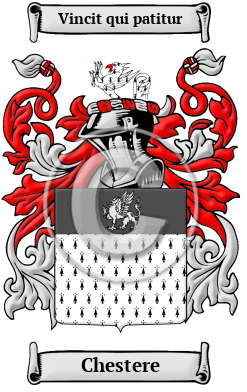
The motto was originally a war cry or slogan. Mottoes first began to be shown with arms in the 14th and 15th centuries, but were not in general use until the 17th century. Thus the oldest coats of arms generally do not include a motto. Mottoes seldom form part of the grant of arms: Under most heraldic authorities, a motto is an optional component of the coat of arms, and can be added to or changed at will; many families have chosen not to display a motto.
Motto: Vincit qui patitur
Motto Translation: He conquers who endures.
- Lower, Mark Anthony, Patronymica Britannica, A Dictionary of Family Names of the United Kingdom. London: John Russel Smith, 1860. Print.
- Mills, A.D., Dictionary of English Place-Names. Oxford: Oxford University Press, 1991. Print. (ISBN 0-19-869156-4)
- Arthur, William , An Etymological Dictionary of Family and Christian Names. London: 1857. Print
- Smith, George (ed), Dictionary of National Biography. London: Smith, Elder & Co., 1885-1900. Print
- Reaney, P.H and R.M. Wilson, A Dictionary of English Surnames. London: Routledge, 1991. Print. (ISBN 0-415-05737-X)
- Dickinson, F.H., Kirby's Quest for Somerset of 16th of Edward the 3rd London: Harrison and Sons, Printers in Ordinary to Her Majesty, St, Martin's Lane, 1889. Print.
- Bardsley, C.W, A Dictionary of English and Welsh Surnames: With Special American Instances. Wiltshire: Heraldry Today, 1901. Print. (ISBN 0-900455-44-6)
 |